Adaptive Memory Raised Coverage While Fixed Memory Stayed More Accurate
Aggregated class cards replaced individual references, and the adaptive arm added reviewed examples during a 72-acquisition Ottawa stream. The added coverage came mostly from additional wrong labels, so the fixed arm remains the more accurate one. The 32 reserved acquisitions stay closed for a later evaluation.
| Outcome on 72 stream acquisitions | Fixed memory | Adaptive memory |
|---|---|---|
| Correct automatic recognition | 16 | 18 |
| Wrong automatic assignment | 11 | 41 |
| Review required | 45 | 13 |
Class-memory results, protocol and scope. The published page summarizes the aggregate counts.
Removing Three Diagram Types Recovered One Case And Exposed Repeat Variability
Four recordings, each tested with its class present and excluded, using the 26-diagram input. These eight primary decisions are development cases; the repeat evidence is reported separately.
| Observed outcome | Complete input | Three views removed |
|---|---|---|
| Correct primary decisions | 5/8 | 6/8 |
| Correct recognition, class present | 1/4 | 2/4 |
| False rejection, class present | 3/4 | 2/4 |
| Correct rejection, class excluded | 4/4 | 4/4 |
| D03 known-class pair of identical requests | Other / Other | Other / wrong C06 |
The removed views are band power, autocorrelation and dominant-frequency tracking, including their explicit numerical evidence. The model studied the 23 retained diagram types; the pruning comparison displays four essential views.
Complete crossed-study evidence
46 per-request outcomes / Factorial, regression and repeat comparisons / Selected recording provenance
All 32 primary factorial decisions on D03/D07 answer Other across the eight removal combinations. Removing spectral kurtosis alone leaves D07 unchanged. Every request completed without transport errors.
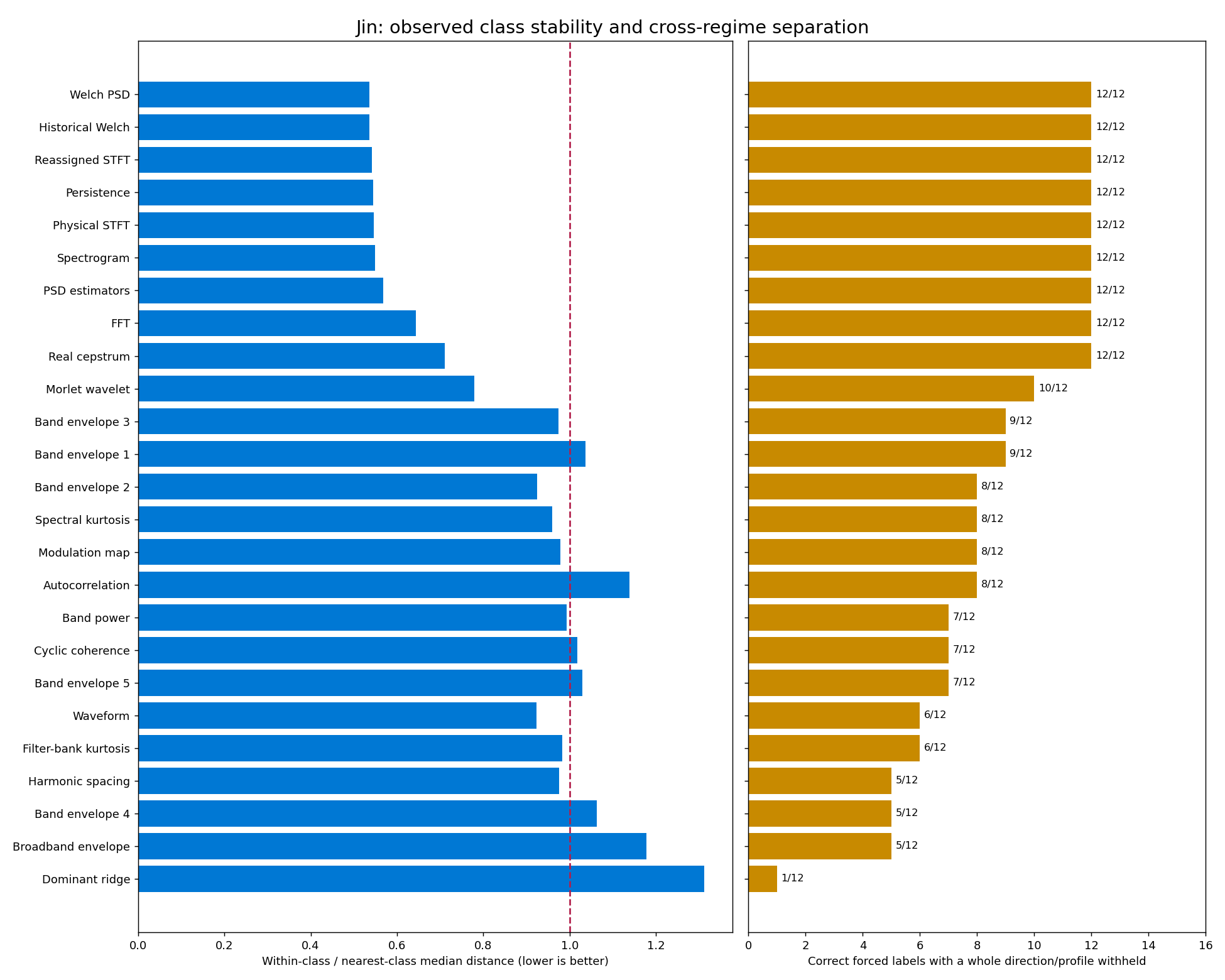
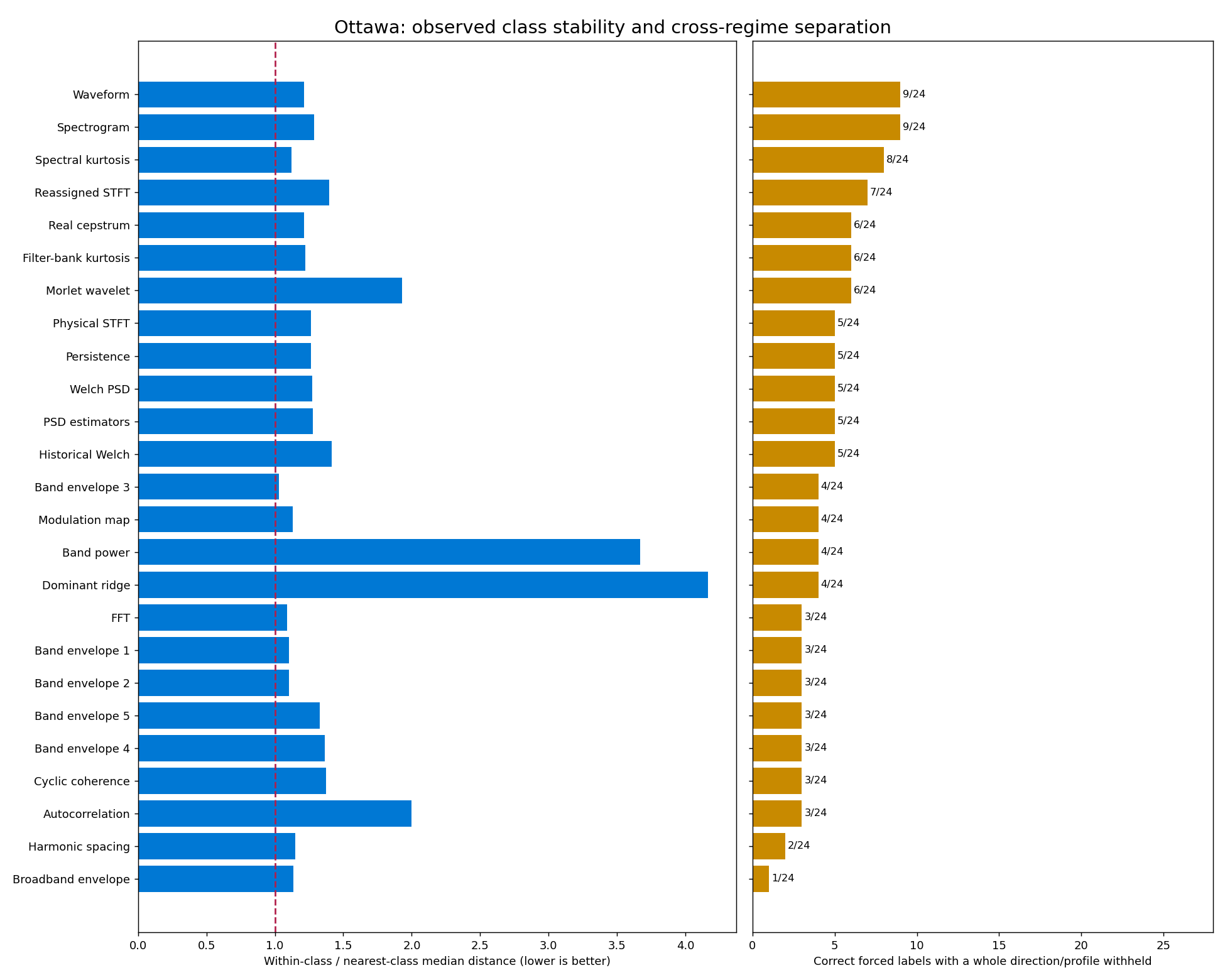
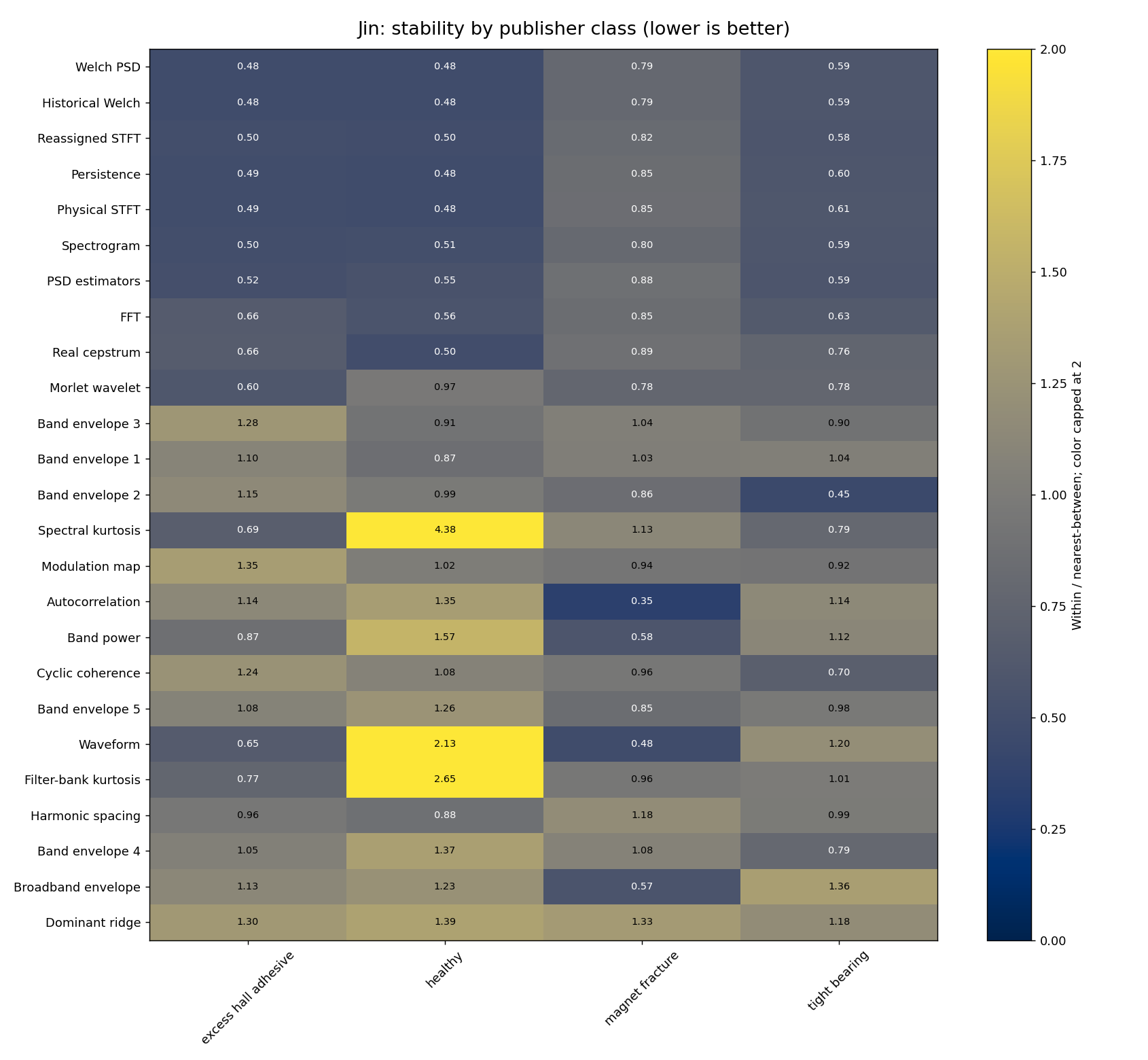
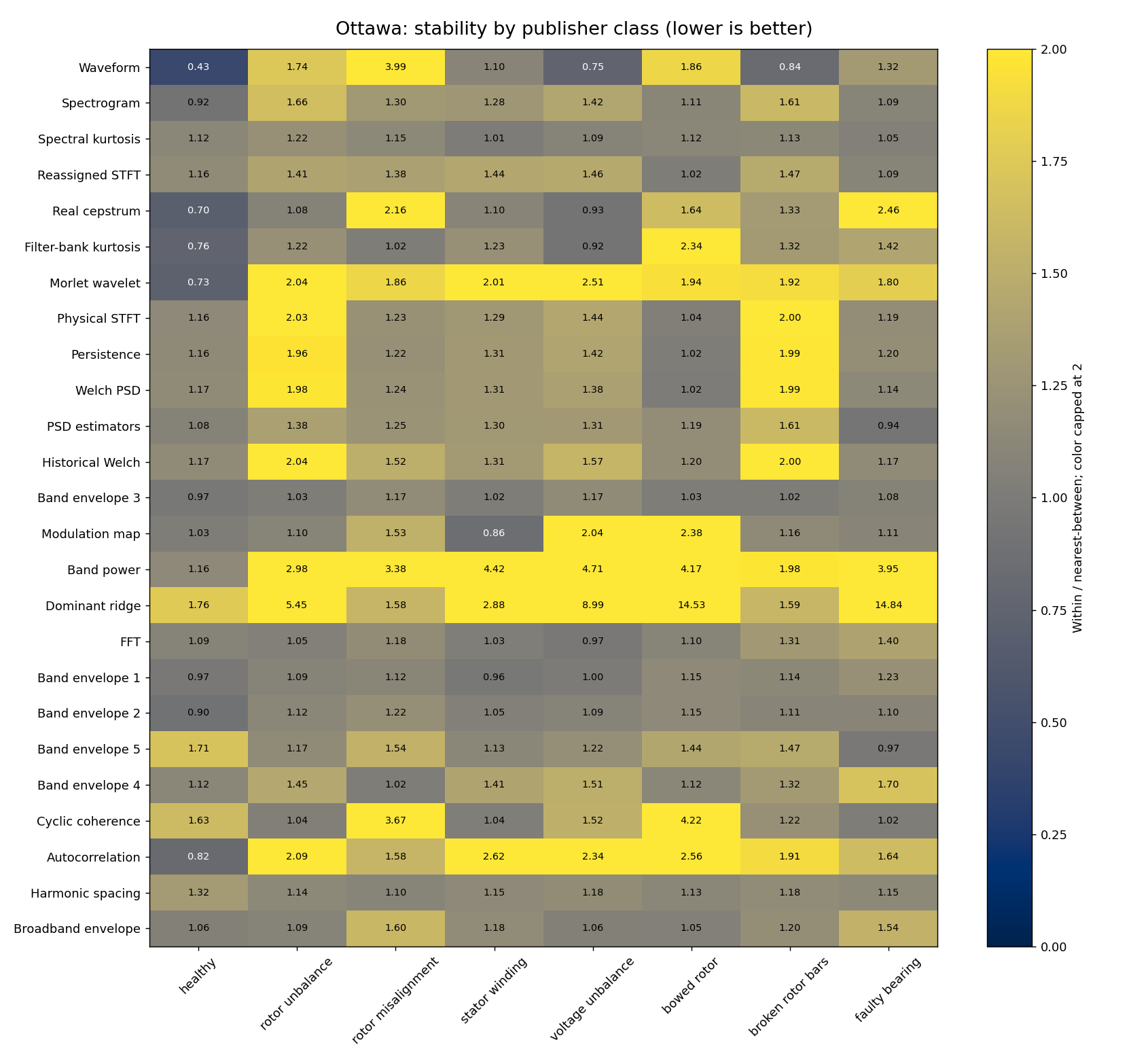
Spectra Separate Jin Families Across Directions; Ottawa Families Overlap Across Profiles
Full spectral representations group the observed Jin acquisitions by condition, while Ottawa families overlap across operating profiles. These forced-label checks use acquisition groups from the published datasets.
Every Decision Can Be Checked
Publisher labels and model answers are shown side by side for review. Blind listening comparisons and fresh recordings are the next validation steps.
Audio attribution and modifications / Archive hashes / Publication and reproduction policy